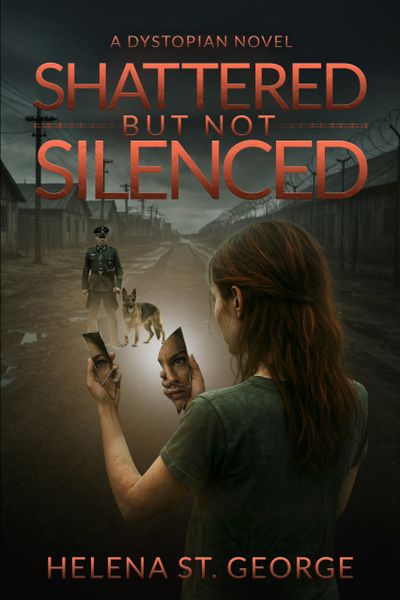
Dystopia Meets Near-Future Reality
They took her future.
They took her freedom.
They never expected her to fight back.
Inside the New Thought Center, an authoritarian regime strips citizens of their identities and reprograms them into obedience. To survive, Maya documents what she sees in secret sketches. When she releases her drawings under the hashtag #ThePhantomSpeaks, they expose the regime's darkest secrets and spark a growing resistance movement.
But resistance is dangerous. And the government is determined to find the anonymous artist before the truth spreads any further.
Shattered But Not Silenced is a gripping dystopian novel about survival, trauma, identity, and the power of one voice to challenge an entire system. Told from the perspective of a complex neurodivergent female protagonist, this psychological dystopian drama explores trauma, resilience, and the moral cost of speaking truth under authoritarian rule.
Shattered But Not Silenced meets The Institute by Stephen King and The Handmaid’s Tale. They depict terrifying, authoritarian regimes where vulnerable characters (disabled, homeless, children, or women) are trapped, stripped of their identities, and reprogrammed or exploited. The narratives focus on characters fighting for agency against oppressive institutions.
Let's Discuss Together
Book clubs are where stories really come alive. If it works with my schedule, I’m glad to join your discussion virtually whether that’s a few minutes to say hello or a longer Q&A. Interested? Send me a note through the Sign Up/Contact link below with your meeting details and I’ll be in touch.
What Readers are Saying:
From Lillian via email:
My name is Lillian and while reading about Shattered But Not Silenced,I was struck by how powerfully the novel blends dystopian storytelling with questions that feel increasingly relevant in today's world.
What immediately stood out to me is that this is far more than a dystopian novel about a future society.
At its core, it appears to be an examination of human worth, identity, and the consequences of measuring people solely by their perceived usefulness. Those themes resonate deeply because they touch on conversations that many individuals, families, educators, advocates, and policymakers are already having.
The premise feels both unsettling and profoundly thought-provoking. A society that determines value through productivity alone creates a chilling backdrop, but what makes the story especially compelling is Maya's perspective. Her experience as an autistic young woman navigating a system designed to erase individuality transforms the novel from a political dystopia into something intensely personal and emotionally resonant.
What impressed me most is the care given to Maya's voice. Authentic portrayals of neurodivergence remain relatively rare, and readers are increasingly seeking stories that move beyond stereotypes to present nuanced, fully realized characters. By combining Maya's perspective with themes of resistance, identity, and self-determination, Shattered But Not Silenced appears positioned to create meaningful connections with readers both inside and outside the neurodivergent community.
From Akeem via email:
Hi Helena,
I read through Shattered But Not Silenced, and the detail that stopped me is the smallest one: Maya's drawings start as something private, just a way to process what she's survived, before they ever become resistance. Most dystopian fiction skips straight to the rebellion. You let art be self-preservation first, and only later let it become political, which is a much truer account of how resistance actually starts in real people's lives.
What makes this hit so hard, though, is who you chose to center it on a neurodivergent protagonist surviving a system explicitly built to "rehabilitate" the disabled and the unproductive. It isn't a metaphor you're reaching for from a distance. In a society that measures human worth by productivity, one autistic woman's drawings become the resistance no one saw coming.
Forced into a New Thought Center built to "rehabilitate" the disabled and the unemployed, Maya survives the only way she can, through art, until her smuggled sketches ignite a movement under #ThePhantomSpeaks. Your dystopian novel refuses to look away from its hardest question: who decides what makes a life valuable? This is dystopian fiction with genuine emotional and social depth.
The line "who decides what makes a life valuable, and what happens to those who do not fit the standard" is the kind of question that doesn't resolve neatly, and that's exactly why I related to Maya and not just to the plot around her.
From Yvonne via email:
There are certain dystopian novels that do more than depict oppressive systems; they explore the emotional cost of silence, the fragility of identity under control, and the transformative power of creativity as resistance. Shattered But Not Silenced is one of those works.
What immediately stands out in your novel is its powerful fusion of psychological dystopia and artistic expression. Maya’s story, told through trauma, observation, and illustration, creates a narrative voice that feels both intimate and urgently political, grounding the larger dystopian world in deeply personal experience.
I was especially drawn to the concept of art as resistance. The idea that Maya’s drawings, as initially a means of survival and emotional processing, become a catalyst for awareness and rebellion adds emotional depth to the story.
The emergence of the underground movement through #ThePhantomSpeaks is particularly intriguiging. It transforms the narrative from personal survival into collective awakening, showing how truth can spread even under systems built to suppress it.
I also appreciated the psychological depth of Maya as a neurodivergent protagonist. Her perspective adds authenticity, nuance, and emotional complexity to the narrative, especially as she navigates trauma, institutional control, and the challenge of reclaiming identity in a system designed to erase it.
The depiction of authoritarian control through the New Thought Center is especially striking. The focus on thought regulation, forced compliance, and the reduction of human worth to productivity creates a chilling but believable framework that heightens the stakes of every action Maya takes.
Most compelling of all is the central theme of voice and visibility. The novel consistently asks what it means to speak in a world that punishes truth, and how survival itself can become an act of resistance when expression is forbidden.
The combination of dystopian tension, psychological realism, neurodivergent perspective, artistic symbolism, and political resistance gives Shattered But Not Silenced exactly the kind of emotionally charged and thought-provoking storytelling that I, as a reader of modern dystopian fiction deeply connect with.
From Elizabeth via email:
Hello Helena,
I just finished reading Shattered But Not Silenced. There is a certain discipline in the way your work is structured. It never feels overworked or scattered. Instead, every element seems intentionally placed, with each part serving a clear purpose.
Your haunting dystopian novel presents a disturbing vision of a near-future America shaped by economic collapse and authoritarian control. In this society, people are valued only for their contribution, while the most vulnerable are subjected to forced "reform" disguised as rehabilitation.
At the center of the story is Maya, an autistic young woman whose observant, ironic, and quietly defiant voice guides readers through a crumbling social order. When she is sent to the New Thought Center, a facility designed to "re-educate" those deemed unproductive, her experiences reveal the personal cost of surviving a system built on rigid conformity. The pacing remains carefully controlled throughout, allowing both Maya's journey and the broader social critique to unfold with steady impact.
What also stands out is how you handle emotional depth through understatement. You do not force emotion to the surface. Instead, it emerges in quieter moments and subtle observations.
The novel is particularly notable for its authentic and nuanced portrayal of neurodivergence. Maya's sensory experiences, coping strategies, and often humorous inner thoughts are presented with care and depth. As she navigates a journey of resistance, she fights to reclaim her identity and agency.
Through its dystopian lens, the story raises urgent questions: Who defines the value of a human being? What happens to those who fail to meet that standard? By focusing on society's outcasts, the narrative highlights the human cost of a system that values productivity over humanity.
I was looking for more than simple entertainment. The novel offers sharp social insight, memorable characters, and an emotionally haunting narrative. It addresses issues such as homelessness, disability, and access to public assistance while blending psychological tension with political stakes. The result is a bold and empathetic story that lingers long after the final chapter.
From Jessica via email:
Hello Helena,
As I spent some time reading Shattered But Not Silenced, one thing stood out to me almost immediately. This doesn't appear to be simply a dystopian novel.
It feels more like an exploration of a question that many people are wrestling with right now, whether they realize it or not. What gives a person value? Is human worth determined by productivity, achievement, and? Or is there something deeper that cannot be measured by systems, institutions, or social expectations?
What struck me most was the way you've approached these questions through Maya's story. Rather than presenting an abstract argument, you've created a character whose experiences invited me to confront these issues from a personal level. Through her perspective, the novel seems to examine what happens when society reduces people to what they produce instead of recognizing their humanity.
The more I reflected on the book, these are the areas that drew me in:
The dystopian setting and the psychological tension.
The novel's exploration of neurodivergence, identity, and belonging.
The broader social questions surrounding disability, homelessness, public assistance, and the way modern societies define success and worth.
The thought-provoking questions that stayed with me long after the final page.
Shattered But Not Silenced appears to sit at the intersection of broader public conversations that challenge conventional thinking.
What I found especially compelling is that beneath the dystopian framework, there seems to be a deeply human message.
A reminder that dignity is not earned through productivity.
A reminder that identity cannot be erased through conformity.
And a reminder that resilience often emerges in the people society overlooks.
That's what gives the book significance beyond the dystopian genre itself.
What impressed me most, however, wasn't the premise.
It was the compassion behind it.
Your novel appears to come from a genuine desire to explore difficult questions about humanity, belonging, and personal worth in a world that often measures people by the wrong standards.
From Judy via email:
My name is Judy. Something about the way you wrote Shattered But Not Silenced, with Maya documenting the atrocities she witnessed inside the New Thought Center, her drawings revealing an authoritarian regime that controlled thought, punished dissent, and reduced human worth to productivity and compliance, stuck with me.
The way Shattered But Not Silenced follows Maya as her sketches become a way of processing trauma and reclaiming identity, then later are released through an underground whistleblower movement under the hashtag #ThePhantomSpeaks, and art becomes resistance, is exactly the kind of dark, psychologically rich dystopian fiction.
And the questions at the heart of Shattered But Not Silenced, "Who decides what makes a life valuable, and what happens to those who do not fit the standard?" This quote stuck with me: "My art was my voice. Maybe one day, someone would listen."
I love dystopian social commentary and stories about fighting for agency against oppressive institutions and your novel delivers both.
From Charles via email:
Hi Helena,
I’ve spent the last several days dissecting the incredibly intense, psychologically profound framework you’ve built in Shattered But Not Silenced. The transition from a neurodivergent protagonist using clandestine drawings to process the trauma of the "New Thought Center" to those sketches becoming the face of an underground whistleblower movement under the hashtag #ThePhantomSpeaks is a masterclass in modern dystopian fiction. You aren't just writing a story about a dark regime; you are offering a "knuckle-deep," raw exploration of institutional oppression and neurodivergent resilience, tracking the exact moral cost of using art as weaponized resistance in a society built on absolute silence.
The way you’ve juxtaposed the clinical, dehumanizing control of a government that reduces human worth to mere compliance with Maya’s deeply personal, emotional sketches is exactly the kind of "cerebral-meets-visceral" energy. I love dystopian social commentary, psychological thriller, and whistleblower fiction. You’ve successfully engineered a first-person autistic narrator whose unique perspective challenges the very definition of human value. It is an "almost perfectly untarnished" blueprint for the Dystopian-Psychological-Drama hybrid with intricate world-building, authentic disability representation, and emotionally devastating tear-jerkers that I find especially intriguing.

Shattered But Not Silenced: A Dystopian novel. Now on Amazon and any bookstore.
We use cookies to analyze website traffic and optimize your website experience. By accepting our use of cookies, your data will be aggregated with all other user data.